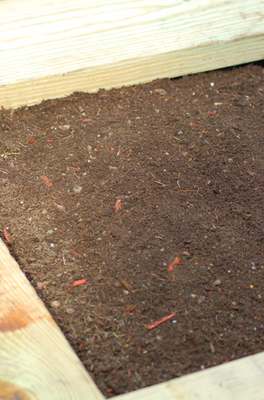
Raised garden bed with filler, compost, and
soil.
Now that you have your raised bed set up and ready to go,
the next step is to add in the planting medium.
You will, of course,
want to add compost, but there are other ingredients to consider as well. If
you have only a small amount of compost to add, you probably need something
else to lighten the soil further. Peat moss comes in handy for this purpose.
But for raised beds as deep as the one we sell, 20" deep,
you may need to use fillers.
While you may very well end up using fillers, there
are three caveats to keep in mind, concerning:
- Drainage
- Settling
- Nitrogen depletion
Drainage for raised beds is a double-edged sword. On the one
hand, you need good drainage; on the other hand, good drainage means
you'll need to water more often. Crushed rock (if you happen to have some
lying around) or similar material provides excellent drainage. However, many
of us aren't crazy about dumping rocks into planting areas; we typically think
more in terms of organic matter when we consider our options for fillers
But organic matter can have its drawbacks. Relatively
fresh material (e.g., recently cut brush) will settle as it decomposes. You'll
have to add more soil at some point to bring the soil level of the raised bed
back up where you want it.
There's another problem regarding the use of organic
material that has yet to decompose: it uses nitrogen as it breaks down,
thereby depleting the soil of nitrogen. So you'll end up having to add
nitrogen to the raised bed's soil to make up for this depletion. But if the
compost you've added to the pile has plenty of nitrogen in it (and it should,
if it contains ingredients such as coffee grounds or manure), you may be able
to compensate sufficiently.
 Gardeners' Corner
Kids'
Garden
Sustainable Garden
Go
Shopping
Gardeners' Corner
Kids'
Garden
Sustainable Garden
Go
Shopping