In June 2002, scientists detected a new exotic wood-boring
beetle feeding on ash trees in southeastern Michigan and adjacent Windsor,
Ontario. The beetle has since been reported in northwest Ohio. Native to Asia,
this new arrival is called the emerald ash borer (Agrilus planipennis),
and it poses a potential threat to all species of native ash (Fraxinus).
Larvae of the beetle feed on the phloem and outer sap of ash trees, creating
borer galleries (holes) that can kill branches and, eventually, entire plants.
The Michigan Department of Agriculture has set up a quarantine zone around the
Detroit area in an attempt to limit the spread of the infestation.
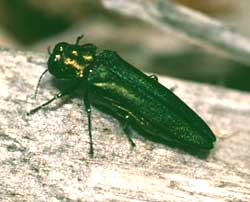
Adult beetles grow between 7 and 13 millimeters long and have
a metallic golden-green color. They begin to emerge in mid-May, and the females
soon start to deposit eggs in the bark crevices of ash trees. Eggs hatch in
seven to ten days. The developing larvae are cream colored and grow up to 22
millimeters long. They bore their way through the bark into the cambial region
and feed on phloem cells and outer sapwood for several weeks. Full-grown larvae
overwinter in galleries in the sapwood and begin to pupate around the end of
April. Adult beetles emerge from small, 3- to 4-millimeter-wide D-shaped exit
holes and continue the life cycle.
Ash trees are often killed after two to three years of
infestation by the ash emerald borer. Control and management strategies for the
beetle are still being developed. Systemic pesticide treatments (using products
with chemicals such as imidacloprid and bidrin) are being administered in
Michigan to trees that are no more than 50 percent dead. It's too early yet to
say how effective these treatments are. Physical control methods, such as
removal and chipping of infested trees prior to beetle emergence in May, are
also being used.
Related Links
For more information on the emerald ash borer, check out these
links:
 Gardeners' Corner
Kids'
Garden
Sustainable Garden
Contact Us
Gardeners' Corner
Kids'
Garden
Sustainable Garden
Contact Us